Talking to our 2024 PCRBIO Research Grant Winner, Isabel Hughes
For her PhD research in Tom Walker’s lab at the University of Warwick, Isabel (Izzy) is investigating something that could shape the future of malaria control: the detection and characterisation of natural Wolbachia strains within Anopheles mosquitoes. Her work relies heavily on endpoint PCR, qPCR, and a range of sequencing methods – much of it carried out not in a pristine lab, but in the field.
As a winner of our 2024 PCRBIO Research Grant, Izzy was given access to PCRBIO products to support her research. We caught up with her to hear how the grant has shaped her work.
Challenges of Field Research
Like all field researchers, Izzy and her team faced a familiar problem: they needed a fast, dependable way to extract mosquito DNA and perform PCR in field locations with relatively limited laboratory equipment.
Choosing PCRBIO
When explaining how she made the move to PCRBIO products, Izzy told us she initially found our Rapid Extract Kit appealing due to the “simple extraction method” and it being “relatively inexpensive”. She also told us she “loved” the PCRBIO HS Taq Mix Red as the included dye made 96-well plate loading “much easier” and therefore helped her reduce errors. We were also pleased to hear that Izzy found our Taq more sensitive in terms of detecting the wsp gene (Wolbachia surface protein), than competitor Taq mixes she had tested (from NEB and Phire).
Looking at her current workflow, she uses our PCRBIO Rapid Extract Kits whilst completing her fieldwork, the PCRBIO HS Taq Mix Red for regular and routine endpoint PCRs and the PCRBIO Ladder IV on her gels.
Results and Impacts
While Izzy’s full optimisation data is being prepared for publication, she was happy to share her team’s experience with the products:
PCRBIO HS Taq Mix Red: When benchmarked against Taq mixes from NEB and Phire, PCRBIO HS Taq Mix Red matched Phire’s superior sensitivity for amplifying the wsp gene in wild Anopheles samples – but at a significantly lower cost, making it the clear choice for the team.
PCRBIO Rapid Extract Kit: Tested the PCRBIO kit (£0.60/extraction) against Promega MagaZorb (£1.23/extraction), Qiagen DNeasy (£2.74/extraction), and PK-TEN buffer (£0.09/extraction) using laboratory-reared stephensi.*
Using the PCRBIO Rapid Extract Kit, extractions took just 20 minutes – far faster than the alternatives tested. DNA yield was comparable to Promega and Qiagen, and more consistent than the PK-TEN buffer technique, with qPCR results on host mosquito genes backing this up.
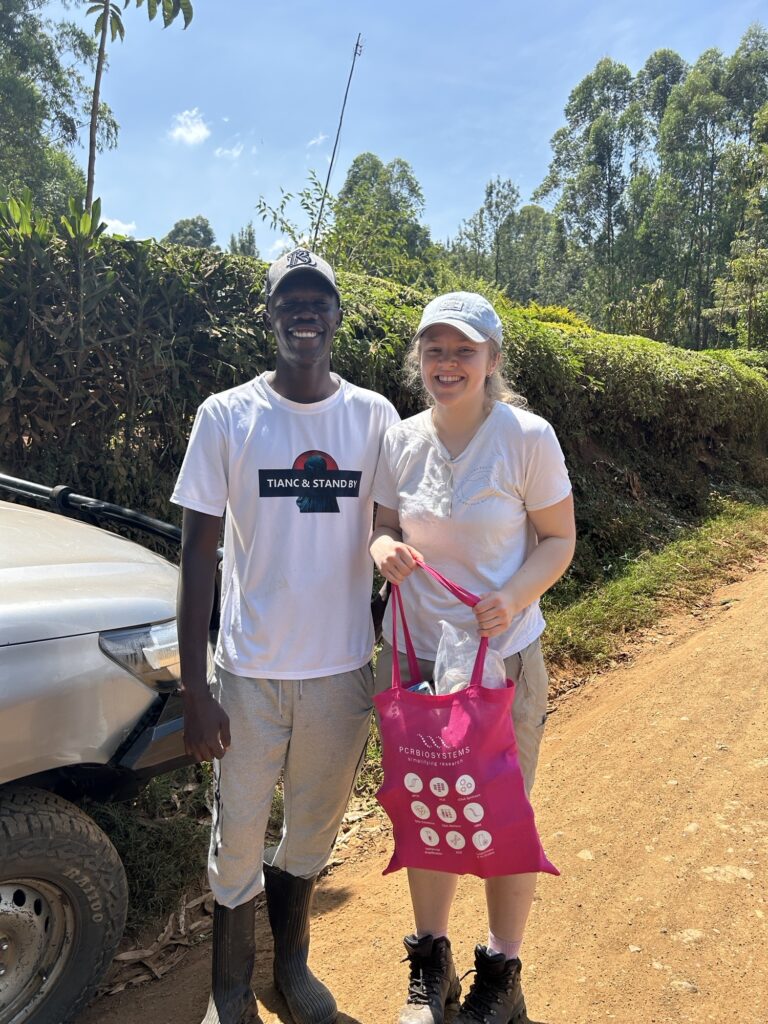
The impact went beyond Izzy’s own lab: she brought the kit to Kenya to share with collaborators who had previously relied on a technique that took an entire day to complete.
Thanks to its speed and field-applicability, the PCRBIO Rapid Extract Kit is now the team’s go-to for fieldwork.

Izzy being presented her PCRBIO Research Grant Winner Trophy by Holly Ross (Account Manager).
Would Izzy recommend PCRBIO?
Without hesitation. “Particularly in our field, based on the results we have seen, it is excellent for field-friendly DNA extractions producing DNA of high quality for downstream assays,” Izzy said. “Also, everyone at PCRBIO is so supportive and friendly and genuinely wants the best for your work!”
We want to thank Izzy for taking part in this interview, and wish her all the best with her research! If you would like to connect with Izzy, you can follow her on LinkedIn here.
Have a research story you’d like featured? Get in contact with us at [email protected]
* Prices accurate at time of writing.