
Talking to Bruno: PCRBIO Research Grant to Gene Therapy Approach for Ataxia-telangiectasia
With our 2026 PCRBIO Research Grant opening for applications in September, we spoke to one of our 2022 runner-ups, Bruno Salomone González de Castejón, to hear about how the grant has helped support his research.
Currently a third-year PhD student at the University of Bristol and part of the Kemp lab, his research focuses on developing a gene therapy approach for ataxia-telangiectasia (AT), a rare inherited childhood disorder caused by mutations in the ATM gene. The condition leads to progressive neurodegeneration, immunodeficiency, and an increased risk of cancer, resulting in a significantly reduced life expectancy. With no effective therapies currently available, treatment remains supportive and palliative — something Bruno is determined to change.
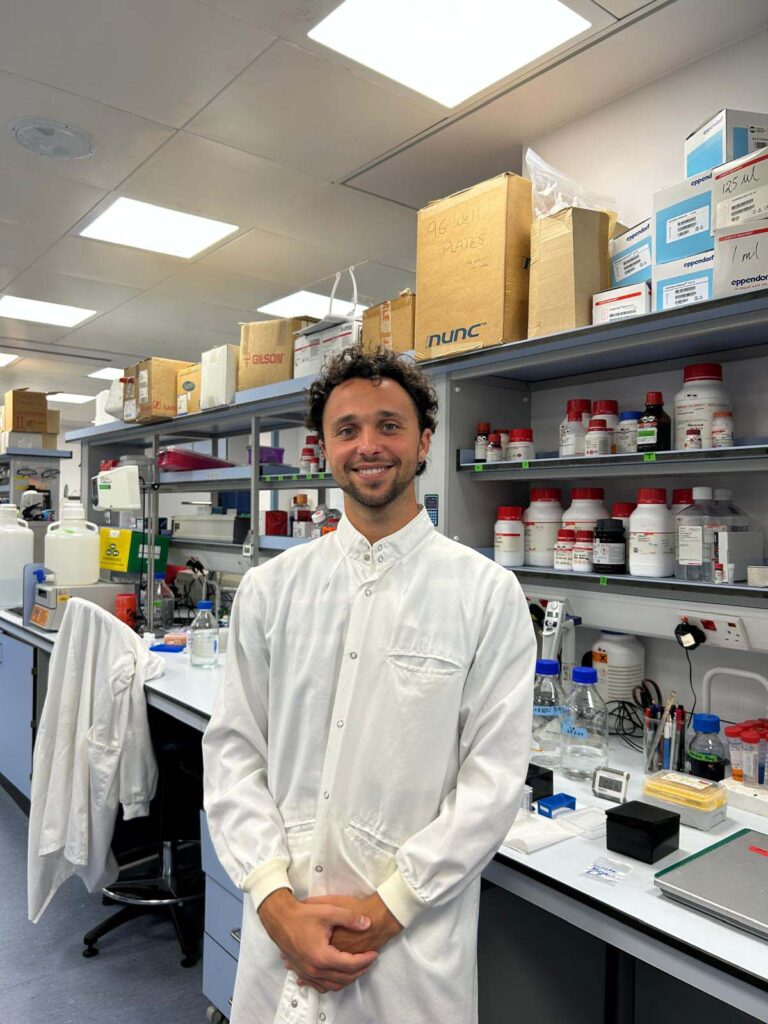
What is your research focus, and what are you currently working on?
Throughout my PhD, I have been investigating whether correcting the genetic defect in patients’ haematopoietic stem cells can restore normal ATM function and provide a long-term therapeutic benefit. We are particularly interested in whether genetically corrected haematopoietic stem cells can migrate to the brain and differentiate into microglia, the brain’s resident immune cells, thereby helping to restore neuroimmune homeostasis. Our goal is to develop a treatment that could address the underlying cause of the disease and ultimately improve outcomes for affected individuals.
What first inspired you to research Ataxia-telangiectasia?
Ataxia-telangiectasia (AT) is considered an ultra-rare disease, with an estimated prevalence of 1 in 100,000 individuals. In fact, unless you are part of the AT community, it’s quite uncommon to meet someone who has heard of the condition at all. I thus feel it’s extremely important to undertake research to better understand AT and develop effective treatments, because in this field even a small contribution can make a meaningful difference to those living with AT.
AT is caused by mutations in a single gene, which makes AT an ideal candidate for gene therapy strategies. Unfortunately, the large size of the ATM gene has been a significant challenge for the development of gene therapy vectors. Since we specialise in gene therapies, we sought to contribute to the development of a vector that could deliver the full-length ATM gene to the affected cells in AT.
I have been fortunate to experience the incredible and supportive community that charities, families affected by AT, clinicians and researchers have created. Their support and dedication are a significant part of what inspires me.
What challenge or limitation were you facing before receiving the PCRBIO Research Grant?
Before receiving the PCRBIO Research Grant, one of the biggest technical challenges in my project was cloning the ATM gene into our gene therapy vector. Molecular cloning is already a demanding process, but ATM is particularly challenging because it is a very large gene (approximately 9 kb). Its size makes it more difficult to amplify, clone and manipulate reliably, meaning experiments often had to be repeated before a successful construct could be generated.
What motivated you to apply for the PCRBIO Research Grant?
My project relied heavily on PCR for cloning, construct validation and routine molecular biology workflows, so reagent costs quickly accumulated. When I came across the PCRBIO Grant, it seemed like an excellent opportunity to help offset some of these essential consumables.
How has the grant helped support your research or career so far? Have you been able to achieve anything new thanks to the grant?
The grant contributed towards the consumables used during the generation and validation of the gene therapy vector that has formed the basis of the rest of my PhD project, which was a particularly rewarding stage of the work. In particular, PCRBIO polymerases reliably amplified my 13 kb DNA fragments with high fidelity, minimising the introduction of unwanted mutations during PCR.

“Receiving the PCRBIO grant was a nice reminder that industry is willing to support early-stage research with real clinical potential.”
How would you describe your experience with the PCRBIO products you used as part of your project?
Throughout my project, I relied on PCRBIO reagents for two key stages: constructing the gene therapy vector and verifying successful clones. To construct the vector, I first had to assemble the 9 kb ATM gene. To this end I used an overlap-extension PCR strategy in which three ~3 kb fragments from ATM were joined together through 20bp homologous overlaps before being inserted into the gene therapy vector. I used the VeriFi® Polymerase for both the linear ligation of the ATM fragments and the subsequent amplification of the whole ATM gene, which allowed me to successfully generate the full-length 9 kb ATM construct while minimising the introduction of unwanted mutations.
To screen the resulting clones, I used PCRBIO HS Taq DNA Polymerase for colony PCR. The ability to amplify DNA directly from E. coli colonies made clone verification quick and straightforward, allowing me to screen more than 200 colonies over just a couple of days.
Was there a specific moment where you felt the grant made a real difference?
As a runner-up recipient, rather than a defining moment, the grant was valuable because it made a practical difference on day-to-day experiments that were essential to moving the project forward. I am truly grateful for the support provided by PCRBIO during this part of my project. Any support for early-career researchers helps maintain momentum on challenging projects and provides valuable recognition for future career development. For our research, every contribution towards essential laboratory consumables helps us continue developing gene therapy approaches for ataxia-telangiectasia, with the long-term goal of improving treatment options for patients.
How would you describe your experience with PCRBIO throughout the grant process?
The PCRBIO team was approachable and supportive from the beginning, and I particularly appreciated that they shared the outcome of the grant in person rather than simply by email. It was a genuinely thoughtful and personal touch that made the process feel much more meaningful. They were also always willing to discuss our experimental needs and recommend products accordingly, helping us to make the most appropriate use of the grant funds.
We would like to thank Bruno for speaking with us. His work on ataxia-telangiectasia is incredibly important, and we are proud to have supported him in his search for a gene therapy. If you would like to read more about Bruno, you can follow him on LinkedIn here.